Hay un largo debate sobre eso, si quieres mirártelo por el foro. Pero en resumen si vale. El 0w16 no existía como tal y se le puso de nombre hybrid.
1 Like
ACEA C2 only exists in W30 oils. ACEA C2 means low HTHS and mid SAPS/ash (suitable for DPF).
For less viscous oils like W20, you need to look for C5 or check the spec sheet if they provide it correctly, and the SAPS/ash parameter should be at a maximum of 0.80.
I just checked the Ravenol spec sheet RAVENOL EFE Extra Fuel Economy SAE 0W-16 | RAVENOL and it has 0.9 Sulphated Ash, which means (>0.8) it’s a full SAPS oil. This can be dangerous for the DPF, especially if you do short trips and don’t monitor the regenerations.
I would definitely try 0W20, but 0W16 seems like going a bit too far to me.
1 Like
It’s not necessarily a full SAPS. That also depends on the phosphorus and sulfur levels in the formulation.
The oil Ravenol EFE Extra Fuel Economy SAE 0W-16 is a modern formulation designed for engines that require low-viscosity, high-performance oils in terms of fuel efficiency. According to current specifications and standards, this oil is *not a “full SAPS,” but rather a *“low SAPS” or “mid SAPS” oil.
Why is it not “full SAPS”?
-
Low Sulfated Ash content: “Low SAPS” oils have a reduced sulfated ash content, generally below 0.8%, to protect emission aftertreatment systems, such as catalytic converters and diesel particulate filters (DPF). Ravenol 0W-16 is designed to meet modern specifications that limit these components.
-
Low phosphorus and sulfur content: “Low SAPS” oils also reduce phosphorus and sulfur levels to minimize the impact on emission control systems. This is typical for oils that meet standards such as **ACEA C5, **API SP, or *ILSAC GF-6.
-
Compatibility with modern engines: This oil is formulated for engines that require low-viscosity and high-efficiency oils, which usually goes hand-in-hand with SAPS restrictions to protect emission systems.
Key specifications of Ravenol EFE Extra Fuel Economy SAE 0W-16:
- Meets standards such as *API SP, or *ILSAC GF-6, which is a specification for “low SAPS” oils.
- Designed for modern gasoline and diesel engines, including those with direct injection and turbocharging systems.
- Optimized to reduce fuel consumption and emissions.
In summary, Ravenol EFE Extra Fuel Economy SAE 0W-16 is a “low SAPS” oil, not “full SAPS,” as it is designed to meet the requirements of modern engines and emission control systems.
1 Like
Where did you get that text from? It looks like it’s from ChatGPT or someone who doesn’t have a clue.
To be Mid SAPS, it must have a maximum ash content of 0.8. In addition to the sulfur requirement, all conditions must be met.
To be Low SAPS, it has to be a maximum of 0.6 or 0.5 (I don’t remember exactly) ash.
Regarding sulfur, I don’t know the measurements, but if it doesn’t meet the ash requirement, it’s no longer Mid (let alone Low) SAPS.
In that very text, it says so itself:
Then it says this:
This is completely made up; these are modern standards where there isn’t much ash, but they don’t have to be Mid (and much less Low) SAPS.
There are plenty of Full SAPS oils with those standards; the difference is that they used to have 1.2–1.5 ash and now those Full SAPS usually have around 1.
If the ash is more than 0.8, it’s a Full SAPS oil, that’s all there is to it.
In gasoline cars with a particulate filter (usually called GPF), there’s no problem if you go a bit over the ash limit, since in gasoline it burns more easily and doesn’t cause issues.
In diesel (FAP, DPF), it’s harder to burn this soot, so with an oil that exceeds the ash limit, soot can form that is then very hard (or even impossible) to burn off.
*I think on the website I shared, Ravenol’s own site clearly states it has 0.9 ash, so there is no doubt that it is NOT a Mid or Low SAPS. Being so low-viscosity, they probably had to use a few extra additives to make a good oil.
Mannol doesn’t even provide that information, so imagine what could come out of there.
1 Like
Well, I got it from DeepSeek. And as it tells you: “GENERALLY” does not mean always. SA value below 0.8%. I repeat, not always. Why? Because you have to look for the relationship between sulfur and phosphorus.
Another fact:
Meaning of the SAPS acronym
- (SA): Sulfated Ash
- (P): from the chemical symbol for Phosphorus
- (S): from the chemical symbol for Sulfur
And finally, don’t forget the manufacturer’s certifications included with the oil and what the manufacturer itself recommends in its PDF.
HONDA 08232-P99D-4LHE (AFTER THE D IT INDICATES THE LITERS OF THE PRODUCT; IT MAY SAY 4L OR 1L)
https://www.coxmotorparts.co.uk/honda-approved-oils/genuine-honda-earth-dreams-technology-diesel-engine-oil-1-litre/
As you’ll see, it’s their genuine oil which carries the same certification as Ravenol and Mannol.
1 Like
Look, if you’re asking an AI, you’re making a mistake. Mid SAPS means that the ashes are less than 0.8, and low SAPS means even less. This has to be met no matter what; if it’s not met, it’s neither mid nor low SAPS. That’s an objective, official, and clear ACEA rule. And they also have to meet a maximum sulfur limit; it’s not like one thing can replace another. You can see this clearly here: in the first table, I have the official ACEA limits, not the nonsense your AI is pulling. https://youtu.be/W5sEiGREekY?si=3TgdOt76QuER-ixz
Then, the Honda mention is not a certificate; it’s a recommendation. This means it’s not certified, it’s only recommended.
And even so, where do you see in the Ravenol Efe that it has that recommendation (or certificate)? I’ll send you the Ravenol website again because I don’t know what you’re looking at, and the Mannol one: RAVENOL EFE Extra Fuel Economy SAE 0W-16 | RAVENOL
MANNOL Hybrid SP 0W-16 7920 - Mannol
I already said it here, they have the … P99S both Ravenol and Mannol. The one from Honda, that you just sent, is P99D. The S is for the hybrid model oil, which, as I said, usually doesn’t have filters or particles or cause problems. https://www.coxmotorparts.co.uk/honda-approved-oils/genuine-honda-hybrid-engine-oil-1-ltr-honda-green-oil
And no, it’s not the same oil. You can ask Coxmotors for the SDS of both oils, and they will give them to you, and you’ll see they are different oils just by looking at the data on their sheets.
3 Likes
If someone is going to use AI to reply in a forum, it’s recommended to either use a quote indicating it comes from an AI—like the wall of text that was pasted here—or indicate in some way that AI was used. AIs can have hallucinations, and an incorrect answer can confuse readers.
5 Likes
That’s why I always put “from the bar counter” when I’m writing from the cafe.
Morrillu: this one was from the bar counter
4 Likes
Well, an AI and morrillu are very well matched; they give a lot of information and can hallucinate 
3 Likes
I’m bringing up the topic again. How did it go with the 0w16, did you notice any difference over time? Better or worse than before?
And by the way, as I mentioned, the Ravenol EFE 0w16 corresponds to the Honda green hybrid (P99S 1LHE), not the diesel one (P99D 1LHE). You can order from Coxmotors or other stores and find their SDS which have quite a bit of information about the oils, I was comparing them and it was clear that they were obviously different oils.
1 Like
So, to be more specific, is there a direct equivalent to Honda Green Diesel 0w16 oil (the original) with any of Ravenol, Mannol, or another brand, or are there only equivalents in 0w20? If I had a diesel, I’d be completely confused.
1 Like
Well, the thing is that I’ve noticed that a few seconds after starting the car, the engine area makes a bit of noise for a few seconds and then it goes away… we’ve always used 0w30, the car was bought with 74 and now it has 190k…
With the confusion you all have about which oil and which not… one no longer knows which is which, but I appreciate the effort… let’s see if they give feedback on that 0w16…
Now, if 0w20 can already be very thin, and considering the temperatures in Spain, specifically Toledo, and the number of kilometers my wife does (about 35k/year), do you recommend going below 0w30?
1 Like
Can you share the SDS?
1 Like
Hello, I’m not sure if I mentioned it here before.
I went to do the maintenance on the Honda and asked for the oil with the reference recommended by some Excel sheet I found online for our engine.
This is the budget they gave me. In the end, I changed the pollen filter myself and saved some money.
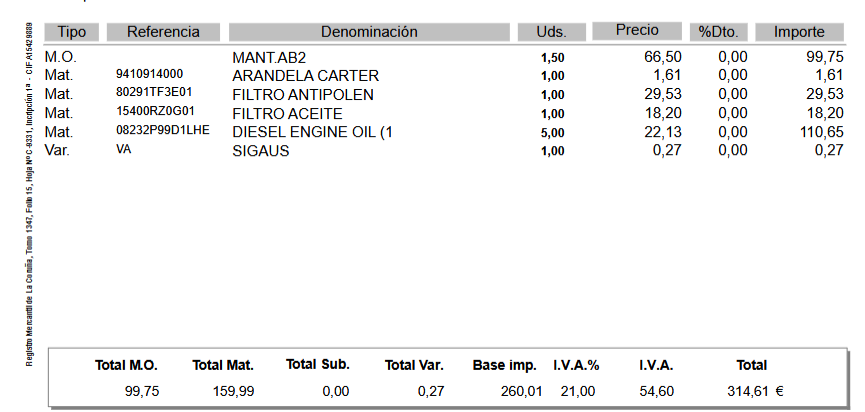
At first, I got the impression that it was a bit smoother than what they were using during the contracted maintenance, but maybe that was just confirmation bias.
Another thing that caught my attention was that the technician stared at it; it seems it wasn’t the oil they usually worked with in the workshop, and he opened the bottle and looked at it for a few seconds.
Since I don’t use the car much now, and when I do, it’s usually for trips of at least 30 minutes, I couldn’t really tell you…
For the next oil change, I’ll repeat, maybe I’m wasting a bit of money, but I feel more at ease, and I hope this car stays with me for many years, so I’d rather spend the money on maintenance with this oil. (I had asked for a quote at the workshop where I took my old car, and they almost asked for the same amount. In the end, I saved a few euros by changing the pollen filter myself as recommended here, buying one from Amazon, which even seemed better than the original.)
3 Likes
Hello, well, if you type the reference + “sds” into Google, you get:
The green hybrid oil https://webcdn.intercars.eu/files/019931/08232-p99-s1lhe_%231.pdf
The green diesel oil https://webcdn.intercars.eu/files/019931/08232-p99-d1lhe_%231.pdf
In SECTION 3, you will find the ingredients that must be listed, and you will see that nothing matches, not even closely. In section 9, the little information there does not match either.
A good detail is that in 9.1 of the hybrid’s SDS, Kinematic viscosity 31.45 mm²/s (40°C) appears, which 99% corresponds to a 0w16. In the diesel’s SDS, that data is not provided (it states greater than 20.5, but that doesn’t help at all).
I’m really confused too, haha.
But well, it can’t be specified because nothing is 100% confirmed about this. It seems that the only way would be to get a reasonably decent sheet of that oil or to have it analyzed.
1 Like
Temperatures don’t matter much as long as they aren’t extreme and the car is used normally; the thermostat is responsible for regulating the temperature (of the coolant and indirectly that of the engine and oil). For now, I wouldn’t go below 0w30, in any case, the least viscous 0W30 you can find or a mix of 0w30 with 0w20 (my idea is to do something like this for the next change). It’s important that it is Acea C2, nothing of C3 (nor the C2+C3, which are really C3)… What I recommend the most is to change the oil frequently; 35k km per year but what use do you give it, what specific oil, and how often are you changing it?
1 Like
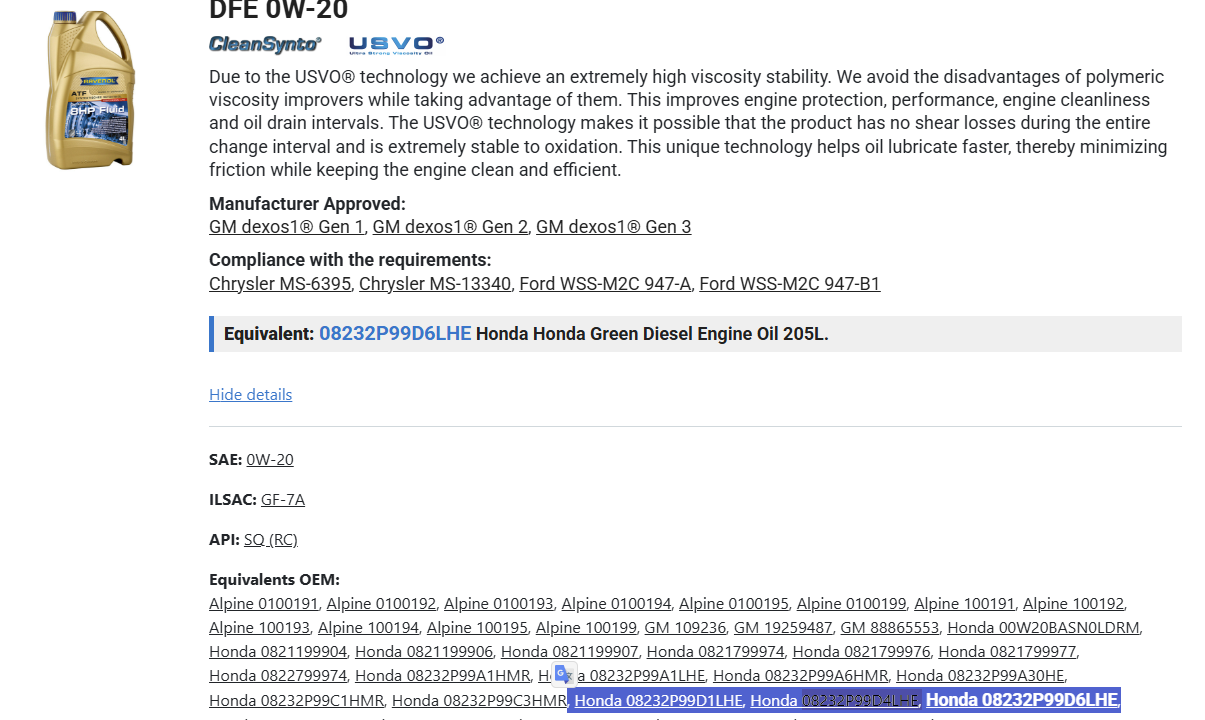
Well, problem solved, right? \nSearch results for 08232P99D6LHE\nIt. Selection of RAVENOL oil. turned out to be 0w20\nExtracted from your SDS file:\n \nFrom the website I link, all the underlined codes:\n
1 Like
Well, I don’t know what area you’re from or what you consider extreme temperatures, but here in Castilla la Mancha and the southern area of Madrid, we’re over 40º in the summer… which happens in other areas too… but for me, that’s extreme 
My wife is self-employed and the IX is her work car, which is why she racks up so many kilometers. The car was bought in 2021 with 74… today it already has 190k… that makes an average of 30k… so the car is more than tested hahaha.
The oil is always changed at our Honda, well, actually all the parts for both Hondas are strictly serviced at the official dealership, so the oil they use is always 0w30. What did it have before? I don’t know, the book is stamped but who knows… but the car wasn’t poorly maintained. And the inspections are also strictly done when the car requires it, and with the kilometers it does, it triggers because of that, due to kilometers.
What I don’t see is mixing 0w20 and 0w30… I’m not really into mixing
Yesterday I saw a video by Juan José from Talleres Ebenezer that talks exactly about the noise we have… he doesn’t mention the Civics, but from what he describes in the video, I “feel” identified with our symptoms.
1 Like
You’re not discovering anything haha. We were discussing the references, they are not from the SDS (that’s how I got the SDS, let’s say). That’s what I was telling Dingo a few messages earlier; when searching for that reference in Ravenol, the DFE 0w20 appears (and not 0w16 as he said). That oil, moreover, looking at its datasheet (RAVENOL DFE SAE 0W-20 | RAVENOL), within 0W20 is actually one of the more viscous and mid SAPS (0.8 ash), which is not far from, for example, a Ravenol FES. Additionally, now API SQ which should protect the chain quite well, could be a great option. Besides, obviously being a quality oil.
But I don’t know if you remember the thread, in another Ravenol file it appeared as 0W16, the v2 of this oil (for Earth Dreams, our engine) they list it as 0W16… https://farm2.staticflickr.com/1896/29512060307_fd4f91622d.jpg

For me… Nothing resolved xD At most, resolved that at least it’s compatible with 0W20, but we don’t know anything for sure, not even that.
1 Like
I am also from Madrid and travel quite a bit around Spain (both colder areas in winter and hotter areas in Spain). Extreme climates are not what we have in Spain. Extremes can be those of Russia for cold and Dubai for heat.
I left the official dealership a long time ago (when the 5-year warranty ended), with inflated prices (as in all official ones), even though I don’t have it very far, they are not like neighborhood workshops I can walk to, the service leaves much to be desired and I’ve been to quite a few around Madrid.
Doing so many kilometers, the oil change will trigger at 20,000 km, I would try to reduce those kilometers, the rest of the maintenance I would do following the computer. If the car has always been taken to Honda, they will have also used 0W30. If you are going to continue taking it to Honda, there isn’t much choice, you stick with the 0W30 haha.
The Ebenezer workshops guy has come up several times, I liked him but he has turned into a real snake oil salesman with his magical products that well… I just watched the video, it does seem like that, or that seeing in forums and such it’s already known to be related to the chain. In a Facebook group, someone changed the chain tensioner and it seems to have fixed it. The “good” thing is that it seems to be just noise for now, I haven’t seen any cases of the chain breaking or anything like that.
One thing I highly recommend is doing a flush on the car. The ones used by moving the car, which don’t contain solvents (so they are not dangerous, you could drive with them always) and clean better. Specifically this one, following its instructions, let’s use it for 50-150 km before the oil change. Xenum M-flush: información y comprar I used it and it was noticeable that it cleaned quite a bit because the oil took a long time to turn black.
1 Like