Hay un largo debate sobre eso, si quieres mirártelo por el foro. Pero en resumen si vale. El 0w16 no existía como tal y se le puso de nombre hybrid.
1 me gusta
Acea C2 sólo existe en aceites W30. Acea C2 significa bajo hths y mid saps/cenizas (válido para fap).
En aceites menos viscosos como los W20 tienes que buscar C5 o mirar la ficha si es que te la dan bien y el parámetro de Saps/ cenizas debe estar máximo en 0.80
Acabo de mirar la ficha del Ravenol RAVENOL EFE Extra Fuel Economy SAE 0W-16 | RAVENOL y tiene 0.9 de Sulphated Ash/ cenizas lo que significa que ( >0.8 ) es un aceite full saps, puede ser peligroso para el fap sobretodo si haces trayectos cortos y no controlas las regeneraciones.
Yo desde luego que 0w20 probaría, 0w16 me parece ya pasarse
1 me gusta
No necesariamente es un full saps. Eso depende también de los niveles de fosforo y azufre en la formulación.
El aceite Ravenol EFE Extra Fuel Economy SAE 0W-16 es una formulación moderna diseñada para motores que requieren aceites de baja viscosidad y alto rendimiento en términos de eficiencia de combustible. Según las especificaciones y estándares actuales, este aceite *no es un “full SAPS”, sino más bien un aceite *“low SAPS” o “mid SAPS”.
¿Por qué no es “full SAPS”?
-
Bajo contenido de sulfato de ceniza (Sulphated Ash): Los aceites “low SAPS” tienen un contenido reducido de cenizas sulfatadas, generalmente por debajo del 0.8%, para proteger los sistemas de postratamiento de emisiones, como los catalizadores y los filtros de partículas diésel (DPF). El Ravenol 0W-16 está diseñado para cumplir con especificaciones modernas que limitan estos componentes.
-
*Bajo contenido de fósforo y azufre: Los aceites “low SAPS” también reducen los niveles de fósforo y azufre para minimizar el impacto en los sistemas de control de emisiones. Esto es típico en aceites que cumplen con estándares como **ACEA C5, **API SP, o *ILSAC GF-6.
-
Compatibilidad con motores modernos: Este aceite está formulado para motores que requieren aceites de baja viscosidad y alta eficiencia, lo que suele ir de la mano con restricciones en SAPS para proteger los sistemas de emisiones.
Especificaciones clave del Ravenol EFE Extra Fuel Economy SAE 0W-16:
- Cumple con estándares como * API SP, o *ILSAC GF-6, que es una especificación para aceites “low SAPS”.
- Diseñado para motores de gasolina y diésel modernos, incluyendo aquellos con sistemas de inyección directa y turboalimentación.
- Optimizado para reducir el consumo de combustible y emisiones.
En resumen, el Ravenol EFE Extra Fuel Economy SAE 0W-16 es un aceite “low SAPS”, no “full SAPS”, ya que está diseñado para cumplir con las exigencias de los motores modernos y los sistemas de control de emisiones.
1 me gusta
De donde has sacado ese texto? Parece de chatgpt o alguien que no tiene ni idea.
Para que sea mid saps se tiene que cumplir que las cenizas sean 0.8 cómo máximo. Además de lo del azufre, tienen que cumplirse todas.
Para que sea Low Saps tiene que ser maximo 0.6 o 0.5 (no recuerdo exactamente) de cenizas.
Lo del azufre, no me sé las medidas pero si no cumple lo de las cenizas ya no es mid (ni menos low) saps.
En el texto ese, mismamente lo dice:
Luego dice esto:
Esto es una inventada completa, son estándares modernos en los que no hay muchas cenizas, pero no tienen por qué ser mid (y mucho menos Low) saps.
Está lleno de full saps con esos estándares, la diferencia es que antes tenían 1,2-1,5 de cenizas y ahora esos full saps suelen tener en torno a 1.
Si las cenizas son mas de 0,8 es un aceite full saps, no hay más.
En coches gasolina con filtro de partículas (gpf suele llamarse) no hay problema por pasarte un poco del máximo de cenizas, ya que en gasolina se quema más fácil y no dan problema.
En diesel (fap, dpf) cuesta quemar más este hollín por lo tanto con aceite que se pasa de cenizas puede formarse un hollín que luego le cueste mucho (o ni pueda) quemarse.
*Creo que en web que he pasado, la propia de Ravenol pone claramente que tiene 0.9 de cenizas, así que no hay duda que NO es un mid ni low saps. Al ser tan poco viscoso seguramente hayan tenido que tirar de unos pocos adititivos de más para hacer un aceite bueno.
Mannol ni da esa información, así que imagínate lo que puede salir ahí
1 me gusta
Pues lo saque del deepSeek, Y como te dice: “GENERALMENTE” no significa siempre. valor de SA 0.8% por debajo. Insisto no siempre. Porque? porque tienes que buscar la relacion de azufre y fosforo.
Otra dato:
Significado de las siglas SAPS
- (SA): Sulfated Ashes, cenizas sulfatadas en ingles
- (P): del símbolo químico del Fosforo (Phosphorus en ingles)
- (S): del símbolo químico del Azufre (Sulfur en ingles)
Y por ultimo no olvides los certificados del fabricante que incluye el aceite y que recomienda el propio fabricante en su pdf
HONDA 08232-P99D-4LHE (DESPUES DE LA D INDICA LOS LITROS DEL PRODUCTO PUEDE PONER 4L O 1L)
Genuine Honda Green Diesel Oil (Earth Dreams Technology) 1.6 i-DTEC Diesel Engine Oil 1 Litre (08232P99D1LPRO) - Cox Motor Parts
Como comprobaras es su aceite genuino que lleva el mismo certificado que el revenol y el mannol
1 me gusta
A ver, si estás preguntando a una IA mal vamos.
Mid saps significa que las cenizas son menores de 0.8, low saps aún menos.
Esto tiene que cumplirse si o si, si no se cumple no es un mid ni low saps, eso es objetivo una regla oficial ACEA y clara.
Y TAMBIÉN deben cumplir un máximo de azufre, también no es que una cosa sustituya la otra.
Aquí puedes verlo claramente, en la primera tabla tienes los limites Oficiales de Acea, no los líos que se está llevando la IA que usas.

Luego, eso de Honda NO es un certificado, es una recomendación. Lo que significa que no está certificado, sólo recomendado.
Y aún asi, donde ves en el Ravenol Efe que tenga esa recomendación (ni certificación)?
Te vuelvo a mandar la web de Ravenol porque no sé qué estarás mirando y la del Mannol
Ya lo dije aquí, tienen la … P99S tanto el Ravenol con el Mannol. La de Honda nuestro que acabas de mandar es P99D
La S es del aceite del modelo híbrido, los cuales como he dicho no suelen llevar filtro o partículas o no dan problemas. https://www.coxmotorparts.co.uk/honda-approved-oils/genuine-honda-hybrid-engine-oil-1-ltr-honda-green-oil
Y no, no es el mismo aceite, puedes pedir en Coxmotors las SDS de ambos aceites que te las darán y verás como son aceites distintos sólo con ver los datos que tienen en las fichas.
3 Me gusta
Lo recomendable si alguien va a usar IA para contestar en un foro es o bien hacer una cita indicando que viene de una IA como el tocho que se ha pegado aqui o indicar de alguna forma que se ha usado IA. Las IA pueden tener alucinaciones y una respuesta incorrecta puede confundir a los lectores.
5 Me gusta
Por eso yo siempre pongo “desde la barra del bar” cuando escribo desde la cafetería.
Morrillu: esta ha sido desde la barra del bar
4 Me gusta
Bueno, una IA y morrillu estan muy parejas, dan mucha información y pueden tener alucinaciones 
3 Me gusta
Buenas refloto un poco el tema. Que tal te fue con el 0w16, llegaste a notar algo al tiempo? a mejor o peor que antes?
Y por cierto, como te comenté el Ravenol EFE 0w16 se corresponde con el Honda green hybrid ( P99S 1LHE) , no el del diesel ( P99D 1LHE). Puedes pedir en Coxmotors u otras tiendas y encontrar sus SDS que tienen bastante info de los aceites, yo las estuve comparando y se veía que obviamente eran aceites diferentes.
1 me gusta
Entonces, por concretar un poco, existe equivalencia directa al aceite Honda Green Diesel (el original) con alguno de ravenol, mannol o alguna marca, o solo hay equivalencias en 0w20? Si yo tuviera un diésel tendría la picha hecha un lío
1 me gusta
Pues el caso es que me he fijado y a los pocos segundos de arrancas el coche suena un poco la zona de motor durante unos segundos y luego se va… siempre llevamos 0w30, el coche se compró con 74 y ahora tiene 190k…
Con el lío que os traéis sobre que aceite y que no aceite… uno ya no sabe cual es cual, pero se agradece la currada… a ver si dan feedback de ese 0w16…
Ahora bien, si el 0w20 ya puede ser muy liquido, y partiendo de la base de las temperaturas que hay en España, en concreto Toledo y con la cantidad de km que le hace mi mujer (unos 35k /año), recomendáis bajar del 0w30?
1 me gusta
puedes compartir los sds?
1 me gusta
Hola, no se si lo comenté por aquí previamente.
Yo he ido a hacer el mantenimiento a la honda y les pedí el aceite con la referencia que salía recomendada por algún excel que encontré en internet para nuestro motor.
Este es el presupuesto que me habían dado. Al final el filtro antipolen se lo cambié yo y algo que me ahorré.
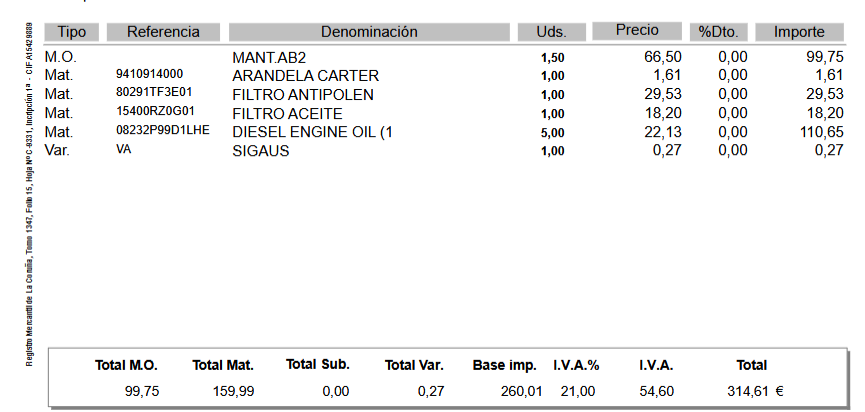
Al principio me dio la impresión de que iba un poco más fino que el que venían poniendo durante los mantenimientos contratados, pero vamos, que igual era sesgo de confirmación.
Otra cosa que me llamó la atención fue que el técnico se quedó mirándolo, se ve que no era el aceite con el que solían trabajar en el taller y abrió la botella y se puso a mirarlo unos segundos.
Como ahora no uso demasiado el coche y si lo uso, suele ser en trayectos de 30 minutos mínimo, pues tampoco os sabría decir…
El próximo cambio de aceite repetiré, igual estoy tirando un poco el dinero, pero me quedo más tranquilo y espero que este coche esté conmigo muchos años así que prefiero dejarme los cuartos en hacer los mantenimientos con este aceite. (Había pedido presupuesto en el taller donde llevaba mi antiguo coche y casi me pedían lo mismo, al final ahorré unos euros cambiando yo el filtro antipolen como me recomendaron por aquí, comprando uno de amazon, que hasta parecía mejor que el original)
3 Me gusta
Buenas, pues según escribes en google la referencia + “sds” te aparecen
El green hybrid oil https://webcdn.intercars.eu/files/019931/08232-p99-s1lhe_%231.pdf
El green diesel oil https://webcdn.intercars.eu/files/019931/08232-p99-d1lhe_%231.pdf
En SECTION 3 te aparecen los ingredientes que tienen que poner obligatoriamente, verás que no coincide nada, ni parecido. En la 9, lo poco que hay verás que no coincide nada.
Un detalle bueno es que en el 9.1 del sds del hybrid aparece Kinematic viscosity 31,45 mm²/s (40°C) lo que 99% que corresponde a un 0w16. En el del diesel no da ese dato (pone mayor que 20.5, pero eso no ayuda nada)
Yo la tengo hecha un lío si jaja
Pero vamos, no se puede concretar porque no hay nada 100% confirmado dde esto realmente. Parece que la única manera sería conseguir una ficha medianamente decente de ese aceite o hacerle un análisis.
1 me gusta
Las temperaturas dan un poco igual, siempre que no sean extremas y se le de un uso normal al coche; el termostato se encarga de regular la temperatura (del refrigerante e indirectamente la del motor y aceite).
Por ahora no bajaría de 0w30, en todo caso el 0W30 menos viscoso que se encuentre o mezcla de 0w30 con 0w20 ( mi idea es hacer algo así para el siguiente cambio). Importante que sea Acea C2, nada de C3 (ni los C2+C3, que son realmente C3)…
Lo que más recomiendo es cambiar el aceite con frecuencia; 35k kms año pero que uso le da, que aceite en concreto y cada cuanto lo estáis cambiando?
1 me gusta
Pues tema resuelto no?
Resulto ser 0w20
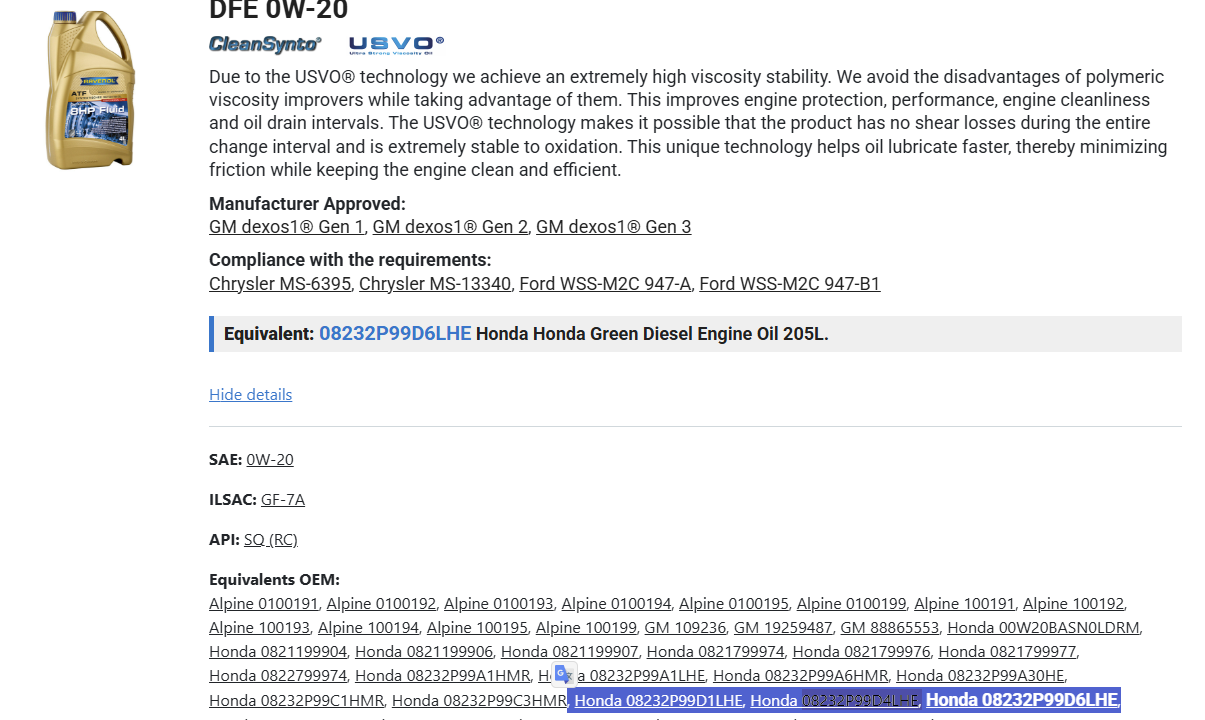
Extraido de tu fichero SDS:

De la web que enlazo todos los códigos subrayados:
1 me gusta
Bueno, yo no sé de que zona eres ni que consideras por temperaturas extremas, pero aquí en Castilla la Mancha y zona sur de Madrid estamos en verano a más de 40º… que en otras zonas también.. pero para mi eso es extremo 
Mi mujer es autónoma y el IX es su coche de trabajo, de ahí que le haga tantos kms. El coche se compró en 2021 con 74… hoy ya tiene 190k… eso hace una media de 30k… vamos que el coche está más que probado jajajaja.
El aceite lo ponen siempre en nuestra Honda, bueno, la verdad es que todas las piezas de los dos Honda se llevan a rajatabla en la conce oficial, así que el aceite que le ponen es el 0w30 siempre. ¿Cuál llevaba antes? no lo sé, el libro está sellado pero vete a saber… pero el coche no estaba mal mantenido. Y las revisiones se pasan también a rajatabla cuando lo pide el coche, y con los km que hace salta por eso, por km.
Lo que si que no veo es lo de mezclar el 0w20 y el 0w30… yo es que no soy muy de mezclas
Ayer vi un video de Juan José de Talleres Ebenezer que justo habla del ruido que tenemos… no hace mención a los civic, pero por lo que describe en e video “me siento” identificado con nuestros síntomas
1 me gusta
No estás descubriendo nada jajaja.
Las referencias las estábamos comentando, no son del sds (son como he conseguido el sds vamos).
Eso es lo que le estaba diciendo yo a Dingo unos mensajes antes; que al buscar esa referencia en Ravenol aparece el DFE 0w20 (y no 0w16 como él decía).
Ese aceite además viendo su ficha (RAVENOL DFE SAE 0W-20 | RAVENOL ) dentro de 0W20 es más bien de los más viscosos y mid saps (0,8 de cenizas), lo que no se aleja mucho de por ejemplo un Ravenol FES. Además ahora Api SQ que debería proteger bastante la cadena, puede ser una gran opción. Además de obviamente ser un aceite de calidad.
Pero no sé si te acuerdas del hilo, en otro fichero de Ravenol aparecía como 0W16, la v2 de este aceite (para earth dreams, nuestro motor) lo ponen como 0W16… https://farm2.staticflickr.com/1896/29512060307_fd4f91622d.jpg

Para mi… Resuelto nada xD Como mucho resuelto que al menos es compatible con 0W20, pero no sabemos nada a ciencia cierta, ni eso.
1 me gusta
Soy de Madrid también y viajo bastante por España (tanto zonas más frías en invierno como más calientes en España). Clima extremo no son los que hay en España. Extremos pueden ser los de Rusia para frío y Dubái para el calor.
Yo huí hace tiempo del concesionario oficial (cuando se acabó la garantía de 5 años), precios infladisimos (como en todos los oficiales vamos), aunque no loa tenga lejísimos no están como talleres del barrio que pueda irme andando, el trato deja bastante que desear y he ido a unos cuantos por Madrid.
Haciendo tantos kms, el cambio de aceite le saltará a los 20.000kms, intentaría reducir esos kms, el resto de mantenimientos si los haría siguiendo el ordenador.
Si el coche lo han llevado siempre a Honda, habrán usado también 0W30. Si vais a seguir llevándolo a Honda, no hay mucha opción se sigue con el 0W30 jajaja
El de talleres Ebenezer me ha salido varias veces, me caía bien pero se ha convertido en un auténtico vendehumos con sus productos magicos que en fin…
Acabo de ver el vídeo, si tiene pinta de ser eso, o esa viendo en foros y tal ya se sabe que está relacionado con la cadena. Un un grupo de Facebook uno cambió el tensor de la cadena y parece que se le arregló. Lo “bueno” es que parece que sólo es ruido por ahora, no he visto ningún caso de partir cadena o algo así.
Una cosa que te recomiendo encarecidamente es hacer un flush al coche. De los que se usan moviendo el coche, que no llevan disolventes (por lo que no son peligrosos, podrías conducir con ellos siempre) y limpian mejor.
En concreto éste, siguiendo sus instrucciones, vamos usarlo durante 50-150kms antes del cambio de aceite. Xenum M-flush: información y comprar yo lo utilicé y se notó que limpió bastante porque el aceite tardó mucho en ponerse negro
1 me gusta